
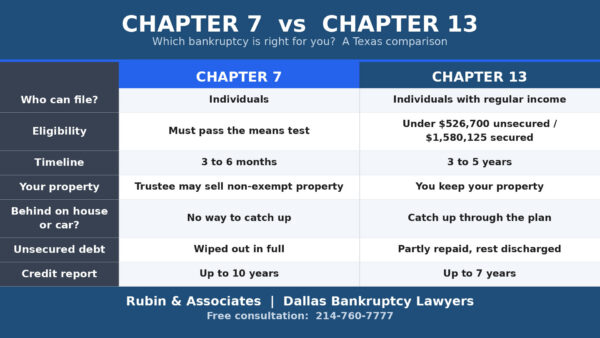
 Most people who consider bankruptcy in Texas face the same first question: should I file Chapter 7 or Chapter 13? The two chapters work very differently, and it is important to understand the differences. Chapter 7 eliminates qualifying debt in a matter of months. Chapter 13 restructures debt into a court-supervised repayment plan that lasts three to five years. Neither is better in the abstract. The right choice depends on your income, your assets, whether you are behind on secured debts like a mortgage or car loan, and what you need the bankruptcy to accomplish. This guide compares the two chapters side by side so you can understand which path fits your situation.
Chapter 7 bankruptcy at a glance
A Chapter 7 bankruptcy is often called liquidation bankruptcy, although in Texas the name is misleading. A court-appointed trustee is authorized to sell non-exempt assets and distribute the proceeds to creditors. In practice, Texas exemption law is among the most generous in the country, so the large majority of Chapter 7 filers keep everything they own. Cases with no assets for the trustee to administer are called no-asset cases, and they are the norm, not the exception.
Chapter 7 cases are handled quickly. Most cases are completed and discharged within three to six months of filing. Credit card balances, medical bills, personal loans, and most other unsecured debts are wiped out completely. There is no repayment plan and no monthly payment to a trustee.
Eligibility for Chapter 7 turns on the means test. The test first compares your annualized household income to the Texas median income for a household of your size. If your income is below the median, you generally qualify. If it is above the median, the test moves to a second stage that deducts allowed living expenses from your income. If meaningful disposable income remains, you may be directed toward Chapter 13 instead. The median figures are updated periodically, so the analysis should always use current numbers (an experienced bankruptcy attorney can assist you here).
Chapter 13 bankruptcy at a glance
A Chapter 13 bankruptcy is a reorganization bankruptcy. Instead of liquidating assets, you propose a repayment plan that lasts from three to five years. A trustee collects a monthly plan payment from you and distributes it to creditors according to the court-approved plan. At the end of a successfully completed plan, remaining balances on most unsecured debts are discharged.
Chapter 13 is available only to individuals with regular income. You do not need to be a wage earner in the narrow sense; self-employment income, Social Security, and other steady sources can qualify. What matters is that your income is sufficiently stable and regular to fund the plan payments.
Chapter 13 also carries debt limits. For cases filed between April 1, 2025 and March 31, 2028, noncontingent, liquidated unsecured debts must total less than $526,700, and noncontingent, liquidated secured debts must total less than $1,580,125, under 11 U.S.C. Section 109(e). These figures are adjusted periodically. Filers whose debts exceed the limits may need to consider Chapter 11 instead.
The defining advantage of Chapter 13 is its power over secured debt arrears. If you are behind on your mortgage, Chapter 13 stops the foreclosure through the automatic stay and lets you repay the past-due amount gradually through the plan while you resume regular payments. The same principle applies to car loans facing repossession and to certain tax debts that cannot be discharged.
Side-by-side comparison
| Factor | Chapter 7 | Chapter 13 |
|---|---|---|
| Typical timeline | 3 to 6 months to discharge | 3 to 5 year repayment plan |
| Income requirement | Must pass the means test | Must have regular income to fund a plan |
| Debt limits | No debt limits | Less than $526,700 unsecured and less than $1,580,125 secured (current figures) |
| What happens to your house | Keep it if payments are current and you reaffirm the mortgage | Keep it and catch up on missed payments through the plan |
| What happens to your car | Keep it if payments are current | Keep it and cure arrears; possible interest rate or balance adjustments in some cases |
| Non-exempt property | Trustee may sell it for creditors | You keep it, but the plan must pay creditors at least what they would receive in Chapter 7 |
| Unsecured debt | Discharged in full at case end | Paid in part through the plan; remainder discharged at plan completion |
| Attorney fees | Generally paid before filing | Often paid through the plan over time |
| Credit reporting | Remains on credit reports for up to 10 years | Remains on credit reports for up to 7 years |
| New credit during the case | Case ends quickly, so rarely an issue | Generally requires court permission |
The means test: the gatekeeper for Chapter 7
The means test deserves a closer look because it determines the chapter for many filers. Congress added it to reserve Chapter 7 for filers who genuinely cannot repay their debts.
The first stage is a simple income comparison. Your average monthly income over the six months before filing is annualized and compared to the Texas median income for your household size. Fall below the median and you pass. The medians are published by the Census Bureau and updated on a regular cycle.
If your income exceeds the median, the test continues to a second stage that subtracts allowed expenses: housing, transportation, food, health care, and other categories, using a mix of national standards and your actual costs. What remains is deemed disposable income. If that figure is high enough to fund a meaningful repayment plan, the presumption is that you belong in Chapter 13.
Passing or failing the means test is a mathematical exercise, not a moral judgment. Many hardworking households with above-median income still qualify for Chapter 7 once legitimate expenses are deducted. An attorney runs the full calculation before recommending a chapter, because filing under the wrong chapter wastes time and money.
Which chapter if you are behind on your house or car?
Falling behind on secured debt is the clearest signal pointing toward Chapter 13. Chapter 7 has no cure mechanism: if you are three months behind on your mortgage, the lender can proceed toward foreclosure even after your unsecured debts are discharged, because the lien survives the bankruptcy.
Chapter 13 was designed for exactly this problem. The automatic stay stops foreclosure and repossession on the filing date. Arrears are then repaid through the plan over its three-to-five-year life while you make ongoing payments. For a homeowner $12,000 behind on the mortgage, a five-year plan spreads the catch-up at roughly $200 per month on top of the regular payment. Many families who could never assemble $12,000 at once can manage that structure.
Chapter 13 can also address second mortgages in certain situations. When a junior lien is wholly unsecured because the home is worth less than the first mortgage balance, the lien may be stripped and reclassified as unsecured debt. This remedy is available in Chapter 13, not in Chapter 7.
Which chapter if you have assets to protect?
Texas exemptions protect most of what ordinary filers own. The homestead exemption has no dollar limit on value. Personal property exemptions cover up to $50,000 for a single adult and $100,000 for a family, including vehicles, household goods, and tools of the trade. Retirement accounts that qualify under federal law are generally fully protected.
When non-exempt equity does exist, the chapters treat it differently. In Chapter 7, the trustee can sell the asset and distribute the proceeds. In Chapter 13, you keep the asset, but your plan must pay unsecured creditors at least as much as they would have received if the asset had been liquidated in Chapter 7. This is called the best-interests test, and it sets the floor for plan payments.
For filers with meaningful non-exempt assets they want to keep, Chapter 13 is often the practical answer, even when Chapter 7 is available.
Can you switch chapters later?
Yes, in many situations. A Chapter 13 debtor generally has the right to convert the case to Chapter 7. Common reasons include a job loss that makes plan payments impossible or a change in circumstances that makes liquidation the better path. Converting from Chapter 7 to Chapter 13 requires a court motion and is granted when the debtor shows good faith.
Conversion is a safety valve, not a strategy. The initial chapter choice should be made carefully with full information, because conversion adds cost and delay. Still, it is reassuring to know the door is not locked behind you.
How the chapters affect your credit
Both chapters appear on credit reports, but for different periods: up to 10 years for Chapter 7 and up to 7 years for Chapter 13. The practical difference is smaller than many people expect. Most filers see credit scores begin recovering within a year or two of discharge, because the debts dragging the score down are gone and new positive history can be built.
Mortgage programs treat the chapters differently. Waiting periods before qualifying for a new home loan are generally shorter after a Chapter 13 discharge than after a Chapter 7 discharge, which matters for filers who expect to buy a home in the next few years. Your attorney can outline the current program guidelines as part of the planning discussion.
Frequently asked questions
Can I choose which chapter to file?
Within the eligibility rules, yes. If you pass the means test and your debts fall within the Chapter 13 limits, you may qualify for either chapter. The choice then turns on your goals: speed and finality point to Chapter 7, while catching up on secured debts or protecting non-exempt assets points to Chapter 13.
What happens if I fail the means test?
You generally cannot file Chapter 7, but Chapter 13 remains available. The disposable income calculated by the means test often becomes the basis for your Chapter 13 plan payment. Failing the test is not the end of the road; it simply directs you to the repayment chapter.
Is Chapter 13 better for keeping my house?
If your mortgage payments are current, either chapter lets you keep the house. If you are behind, Chapter 13 is usually the better tool because it provides a structured way to cure the arrears. Chapter 7 offers no equivalent mechanism.
Which chapter costs more in attorney fees?
Chapter 13 cases typically involve higher total attorney fees because of the three-to-five-year plan administration. However, much of the fee is often paid through the plan itself over time, while Chapter 7 fees are generally paid in full before filing. The out-of-pocket timing differs more than many filers expect.
Can creditors still contact me during the case?
No. Both chapters trigger the automatic stay on filing, which orders most creditors to stop calls, letters, lawsuits, garnishments, foreclosures, and repossessions immediately. Creditors who violate the stay face court sanctions.
Will my spouse have to file with me?
No. Either spouse may file individually. Texas community property rules mean the filing can affect jointly owned property and community debts, so married filers should get advice on whether an individual or joint filing serves them better.
Get advice for your specific situation
Tables and general rules can only go so far. The right chapter depends on the interaction of your income, your debts, your assets, and your goals, and small details change the answer. The means test calculation alone justifies professional review before you file anything.
Rubin & Associates has guided Dallas-area filers through both chapters since 1991. Our team will help you understand every option available to you so that you can make the best decision for your future. Every consultation starts with a clear-eyed review of your finances and an honest recommendation about which chapter fits.
Call 214-760-7777 for a free consultation. The call is confidential, there is no obligation, and you will leave knowing exactly which chapter serves you best.