
Chapter 7 vs Chapter 13 in Texas: Which Is Right for You?
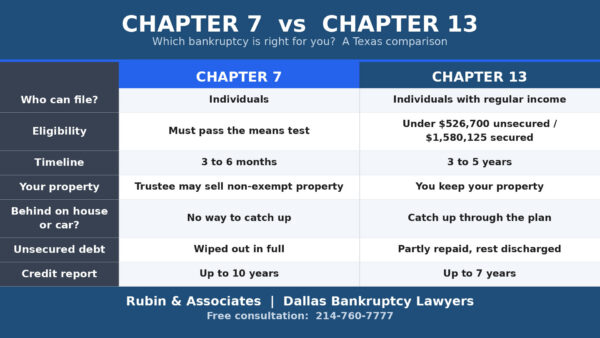
Chapter 7 vs. Chapter 13 bankruptcy in TexasMost people who consider bankruptcy in Texas face the same first question: should I file Chapter 7 or Chapter 13? The two chapters work very differently, and it is important to understand the differences. Chapter 7 eliminates qualifying debt in a matter of months. Chapter 13 restructures debt into a court-supervised repayment plan that lasts three to five years. Neither is better in the abstract. The right choice depends on your income, your assets, whether you are behind on secured debts like a mortgage or car loan, and what you need the bankruptcy to accomplish. This guide compares the two chapters side by side so you can understand which path fits your situation.

Chapter 7 bankruptcy at a glance

A Chapter 7 bankruptcy is often called liquidation bankruptcy, although in Texas the name is misleading. A court-appointed trustee is authorized to sell non-exempt assets and distribute the proceeds to creditors. In practice, Texas exemption law is among the most generous in the country, so the large majority of Chapter 7 filers keep everything they own. Cases with no assets for the trustee to administer are called no-asset cases, and they are the norm, not the exception. (more…)

Which debts are covered in a bankruptcy case?

If you are struggling with debt in the Dallas area, you may be considering bankruptcy as a potential solution. One of the most common questions we hear from potential clients is, “Which types of debt can actually be eliminated or reduced in a bankruptcy case?” The answer depends on your specific situation, the type of bankruptcy you file, and the nature of your debt.

In this post, we will break down the types of debt typically covered in a bankruptcy case, explain the difference between dischargeable and non-dischargeable debt, and help you understand your options. (more…)

What College Students and Graduates Should Know About Bankruptcy

Facts about student loan debt and bankruptcy in DallasCollege is supposed to be an exciting time, full of hope and promises for a bright future. For most students, the real world crashes in once the college ride is over. The job market is tougher than ever before, and even when students find an amazing job, they still have thousands of dollars of student loan debt hanging over their heads.
It’s not uncommon to spend 3 or 4 times as many years paying off student loan debt as you spend in college. With student loan debt spiraling out of control the last few years, we’re getting calls from clients who are younger and younger. If you’re struggling with debt and student loans, there are a few facts you should keep straight about bankruptcy options:

1. Credit card debt is manageable – but can be discharged in bankruptcy

You’ve heard the stories about aggressive debt collection calls – credit card companies are notoriously un-friendly about debt repayment. It’s best to avoid running up large amounts of debt while you’re in college, or shortly after graduation. If you follow a few simple tips, it’s easy for 20-somethings to avoid bankruptcy. If you find that your credit card debt is out of control, it can be discharged through Chapter 7 bankruptcy.
(more…)

By |2015-09-19T14:15:43-05:00September 19th, 2015|Bankruptcy, Student Loan Debt|

Infographic – A Generational Approach of College Student Debt in the U.S.

student-loan-infographicIt’s no secret that student loan debt is a problem in America. Tuition costs continue to skyrocket, and paired with shrinking government financial aid, student loan debt is now the number one debt problem for young Americans.

Just two weeks ago, Congress failed to stop an automatic interest rate hike for Federal Stafford Loans, which doubled interest rates from 3.4% to 6.8% – so the problem just compounded for undergrads across the country. The student loan situation looks pretty bleak for future generations as well.

We stumbled across this infographic this morning and had to share it. It shows the history of college tuition and student loan costs from the 1940’s to today. A few of the staggering stats include:  (more…)

By |2013-07-18T09:34:51-05:00July 18th, 2013|Debt, Student Loan Debt|
Go to Top